
Dabble Rebound Explained: How Matched Bettors Use It
What Is Dabble Rebound?
Dabble Rebound is a promotion that gives eligible customers a chance to receive free bets when their original bet narrowly loses.
For example, you might back a horse to win, only for it to finish second or third. If the race and finishing position meet your Rebound token’s conditions, you can unlock a game containing free-bet rewards.
The game involves revealing tiles while avoiding a bomb. You can stop and collect the rewards you’ve revealed or continue in the hope of receiving more.
For matched bettors, Rebound is interesting because you can calculate a relatively small qualifying loss on the original bet while retaining the chance of receiving a larger free-bet reward.
However, unlike Rocket Boost, Rebound depends on a particular sporting result. A reward is never guaranteed.
How Does Dabble Rebound Work?
The process is straightforward:
- Receive a Rebound token: Check your Dabble account for an available promotion.
- Find an eligible bet: This could be a qualifying horse-racing win single or accumulator.
- Apply the token: Select Rebound before placing your bet.
- Wait for settlement: Your bet must lose in a qualifying way.
- Unlock Rebound: If the result qualifies, the tile game becomes available.
- Reveal rewards: Open tiles containing free-bet rewards while avoiding the bomb.
- Collect your reward: Stop when you’re happy with the amount revealed.
Dabble UK advertises a maximum potential Rebound reward of up to 150% of the applicable stake.
For example, a qualifying £50 stake could offer the chance of collecting up to £75 in promotional value, depending on the particular token and game.
That doesn’t mean you’ll receive £75 automatically.
Which Horse-Racing Bets Qualify?
For horse racing, Rebound generally requires you to back a horse to win and have it finish in a specified near-miss position.
The exact finishing positions depend on the applicable promotion and runner requirements.
The UK terms reviewed in the earlier research describe:
| Runners | Qualifying position |
|---|---|
| 6–7 | Second |
| 8 or more | Second or third |
However, other UK-facing descriptions specify a minimum of eight runners, and Dabble’s published documentation is not entirely consistent across jurisdictions.
Before betting, check the current UK token for the minimum odds, runner requirement and qualifying finishing positions.
The current evidence points to minimum racing odds of 2.00.
See Dabble’s UK Rebound guidance and check the live terms on your token.
Why Do Matched Bettors Look at Eight-Runner Races?
Some AiProfit members prefer races with eight or nine runners because the version of Rebound they have discussed can qualify when a horse finishes second or third.
This provides two potential qualifying positions rather than one.
Members also sometimes look at favourites, reasoning that a competitive horse might have a better chance of finishing near the front.
However, a favourite can still finish outside the qualifying positions, and these preferences don’t establish that a particular selection has positive expected value.
How Are Matched Bettors Using Dabble Rebound?
The most common approach discussed in AiProfit’s Discord involves finding a horse with relatively close bookmaker back odds and exchange lay odds.
The objective is to keep the original qualifying loss small while retaining the possibility of triggering Rebound.
Find a Close Match
Suppose you find a horse with the following odds:
| Item | Odds |
|---|---|
| Dabble back odds | 3.60 |
| Exchange lay odds | 3.90 |
You can calculate an opposing exchange lay bet to reduce the difference between the possible betting outcomes.
The gap between the bookmaker and exchange prices determines the qualifying cost.
Apply Your Rebound Token
Before placing the bookmaker bet, check:
- Whether the horse and race qualify.
- The minimum odds.
- The maximum qualifying stake.
- Which finishing positions trigger Rebound.
AiProfit members have reported £50 Rebound stakes, although the applicable maximum may vary by token.
Apply Rebound before confirming the bet.
Calculate the Qualifying Loss
Using the AiProfit Matched Betting Calculator, imagine backing a horse for £20 at Dabble at odds of 3.60.
The exchange lay odds are 3.90, with 2% commission.
| Item | Amount |
|---|---|
| Bookmaker stake | £20 |
| Back odds | 3.60 |
| Lay odds | 3.90 |
| Exchange commission | 2% |
| Lay stake | £18.56 |
| Exchange liability | £53.82 |
| Qualifying loss | Approximately £1.81 |
The calculation produces a small loss whichever way the horse finishes, assuming both bets are fully matched and settled as expected.
However, the Rebound reward is conditional on the horse finishing in the required position.
Wait for the Race Result
There are three possible outcomes.
The horse wins: Your bookmaker bet wins and the exchange lay loses. You receive the normal matched-bet result, but no Rebound.
The horse finishes in a qualifying position: Your bookmaker bet loses, the exchange lay wins and the Rebound game becomes available, subject to the promotion’s conditions.
The horse finishes outside the qualifying positions: Your bookmaker bet loses, the exchange lay wins and no Rebound is awarded.
The original matched-betting calculation may keep the qualifying cost relatively small, but it cannot guarantee that Rebound triggers.
A Real Dabble Rebound Attempt
On 4 November 2026, an AiProfit member discussed backing Valvano in the 17:00 at Kempton.
The prices were:
- £20 bookmaker stake.
- Back odds of 3.60.
- Exchange lay odds of 3.90.
At an illustrative 2% commission rate, the calculated qualifying loss was approximately £1.81.
Valvano finished fifth of nine runners.
That meant the sporting result didn’t trigger Rebound.
This is an important example because it shows that you can incur the qualifying loss without receiving a promotional reward.
What Happens When You Trigger Rebound?
When an eligible bet finishes in the required position, Dabble unlocks the Rebound game.
The game uses a 3×3 grid containing reward tiles and bomb tiles.
You reveal tiles to accumulate promotional rewards.
At any point, you can stop and collect the amount you’ve revealed.
Alternatively, you can continue opening tiles in the hope of increasing your reward.
However, revealing a bomb can reduce the amount collected.
Dabble’s published descriptions differ concerning the precise number of bomb tiles, so the current UK game displayed in your account should take precedence.
What Happens If You Hit the Bomb?
In the £50 examples discussed by AiProfit members, hitting the bomb awarded £20 in free bets.
This represented 40% of the applicable £50 stake.
However, the consolation amount and reward structure depend on the promotion’s conditions.
For example, imagine you’ve revealed £40 in rewards.
You could stop and collect £40.
Alternatively, you could continue revealing tiles.
If the next tile is a bomb, your reward might fall to the applicable consolation amount.
Continuing isn’t automatically the best decision. Sometimes collecting what you’ve already revealed is preferable to risking a smaller reward.
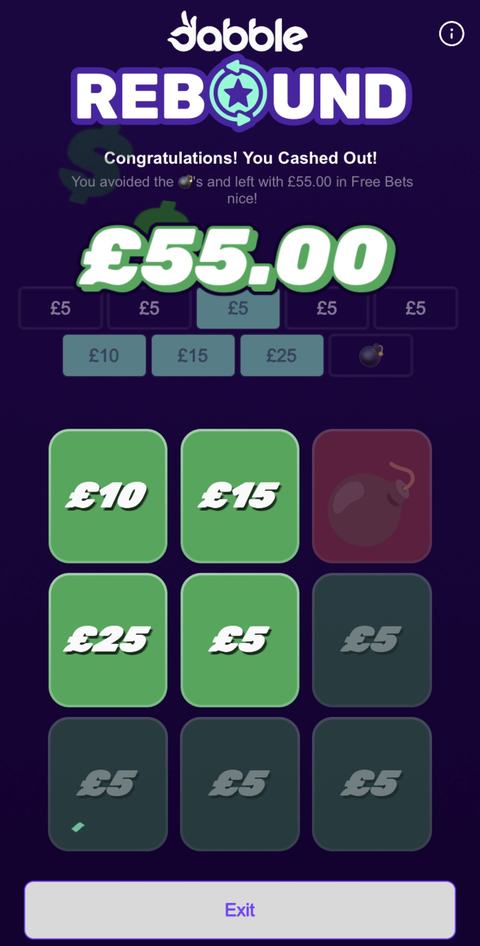
A Real £55 Dabble Rebound Result
On 6 November 2026, an AiProfit member shared a screenshot showing £55 in Rebound free bets.
The member revealed:
| Tile | Reward |
|---|---|
| First | £10 |
| Second | £15 |
| Third | £25 |
| Fourth | £5 |
| Total | £55 |
The member reported a qualifying loss of approximately £3 and described their eventual result as around £40.
However, the screenshot confirms the £55 promotional reward, not the exact cash conversion achieved.
This distinction matters because £55 in free bets isn’t the same as £55 in withdrawable cash.
How Much Are Rebound Free Bets Worth?
Under Dabble’s standard free-bet rules, promotional stakes are generally not returned with winnings.
This is commonly known as a stake-not-returned free bet.
For example, suppose you receive a £20 free bet.
You use it on a selection at odds of 4.00.
If the selection wins, the bookmaker pays £60 in winnings.
The £20 promotional stake isn’t returned.
Matched bettors may calculate an opposing exchange lay bet to reduce the uncertainty of the result, subject to the bookmaker’s terms.
Example: Converting a £20 Free Bet
| Item | Amount |
|---|---|
| Free-bet stake | £20 |
| Bookmaker odds | 4.00 |
| Exchange lay odds | 4.10 |
| Exchange commission | 2% |
| Lay stake | £14.71 |
| Exchange liability | £45.59 |
| Approximate cash value | £14.41 |
In this example, the £20 free bet has an approximate cash value of £14.41 after the hedge.
That’s around 72% of the original promotional face value.
The actual conversion depends on the odds, commission and whether the lay is fully matched.
How Much Can You Make From Dabble Rebound?
There isn’t a fixed amount you can expect from every Rebound attempt.
Your result depends on:
- The original qualifying loss.
- Whether the bet finishes in a qualifying position.
- The reward revealed in the tile game.
- The cash value of the resulting free bets.
- Whether the promotion is available to your account.
For example, imagine a £50 qualifying bet costs £3 to hedge.
If the horse finishes outside the qualifying positions, your result is approximately a £3 loss.
If the horse triggers Rebound and you collect £20 in free bets, those free bets may have a lower cash value after conversion.
If you collect £55 in free bets, the potential value is higher.
However, you cannot assume a particular result will happen.
Understanding Expected Value
A simplified way to evaluate Rebound is:
Expected value = (Chance of triggering Rebound × Average cash value of the reward) − Qualifying loss
For example, suppose:
- Qualifying loss: £3.
- Average reward when triggered: £33.44 in free bets.
- Free-bet conversion rate: 75%.
- Assumed chance of triggering Rebound: 30%.
The calculation would be:
(30% × £33.44 × 75%) − £3 = approximately £4.52 expected value per attempt.
This is a hypothetical model, not a verified average return.
The actual probability of triggering Rebound is unknown and will vary between selections.
A positive theoretical expected value doesn’t guarantee a profit on any individual attempt.
Can You Use Rebound on Football Accumulators?
Yes, eligible accumulators and Bet Builder Multis can qualify for Rebound.
Under the reviewed terms, qualifying accumulators generally require:
- At least three legs.
- Combined odds of at least 3.00.
- Exactly one losing leg.
For example, imagine placing a three-leg accumulator:
| Selection | Result |
|---|---|
| Rangers to win | Won |
| PSV to win | Won |
| Como to win | Lost |
With exactly one losing selection, the bet may qualify for Rebound if the other conditions are met.
However, if two selections lose, the accumulator wouldn’t meet the standard near-miss condition.
Some matched bettors use sequential laying to hedge accumulator legs, but this introduces additional calculations and price-movement risks.
Common Dabble Rebound Mistakes
Assuming Every Losing Bet Qualifies
Rebound requires a specific near-miss.
A horse finishing well outside the qualifying positions or an accumulator losing multiple legs may not trigger the reward.
Confusing Free Bets With Cash
A £50 free-bet reward isn’t equivalent to receiving £50 in withdrawable cash.
The eventual value depends on the promotional conditions and how the free bets are used.
Ignoring the Qualifying Loss
You incur the qualifying cost even when Rebound doesn’t trigger.
Several unsuccessful attempts can therefore produce cumulative losses.
Cashing Out the Original Bet
Dabble’s reviewed rules state that using the sportsbook Cash Out feature on the qualifying bet forfeits Rebound eligibility.
This is different from stopping the Rebound tile game and collecting the rewards already revealed.
Forgetting Token Expiry
Unused tokens, unlocked games and credited free bets can have different deadlines.
Always check the expiry information shown in your Dabble account.
Dabble Rebound FAQs
What Happens If My Horse Finishes Second?
Second place may trigger Rebound if the race and token meet the applicable conditions.
Does Third Place Qualify?
Third place can qualify under versions of Rebound that include third-place finishes in eligible races. Check your UK token before betting.
How Often Do You Get Rebound Tokens?
Tokens are allocated at Dabble’s discretion. Some AiProfit members have reported receiving them on Wednesdays and Saturdays, but there is no verified universal schedule.
What Happens If I Hit the Bomb?
The game may award a consolation amount rather than the accumulated revealed rewards. The amount depends on the applicable promotion.
Can You Use Rocket Boost and Rebound Together?
The reviewed Dabble terms prohibit combining both Rocket Boost and Rebound tokens on the same qualifying bet.
Can You Cash Out Your Original Bet?
Under the reviewed terms, cashing out the qualifying sportsbook bet forfeits Rebound eligibility.
Is Rebound Guaranteed to Make Money?
No. The original qualifying bet can cost money without triggering any reward.
Final Thoughts
Dabble Rebound gives eligible customers a second chance when a bet narrowly loses.
For matched bettors, the opportunity comes from finding a qualifying bet with a relatively small back-to-lay difference while retaining the possibility of receiving free bets.
However, Rebound is conditional. You need to account for unsuccessful attempts, qualifying losses and the actual cash value of any rewards.
This article is educational and does not guarantee profits. Check Dabble’s current UK promotion terms and token conditions before betting.